Property Types We Roof
Review auto dealership roofing in Torrance with separate showroom and service-bay findings, examined exhaust details and complete repair or replacement scopes.
A dealership acquisition needs the roof expenditure separated from the showroom presentation and service equipment the buyer is evaluating. Commercial Roofing Torrance assesses auto dealership roofing in Torrance, CA by locating examined details above the assigned building areas. A polished sales floor does not establish the condition of its roof, and a busy service bay does not establish the cause of an overhead water report. The recommendation connects accessible construction with the work needed to finish a defined correction.
Del Amo Fashion Center is a Torrance retail destination useful for orienting a nearby dealership assessment. The subject property establishes its own vehicle movement, inspection permission and handling restrictions. We record the actual dealership address and assigned roof sections, allowing the acquisition reviewer to relate the allowance to examined premises rather than the surrounding commercial identity.
A showroom and service department can have different roof transitions, interior protection and equipment dependencies.
We compare available building information with accessible roof construction and mark the boundary between the assigned areas. Photographs locate penetrations and changed details so the manager can see what each finding concerns. An observation over one department does not become a replacement quantity for the entire dealership.
Roof work over an open retail floor may share display protection considerations with a showroom. The service department adds its actual equipment and work arrangements. We identify those differences in the estimate, including permission for an interior examination. If the roof geometry or accessible assembly changes at an addition, the scope retains that separate receiving condition instead of assigning one construction method across both areas.
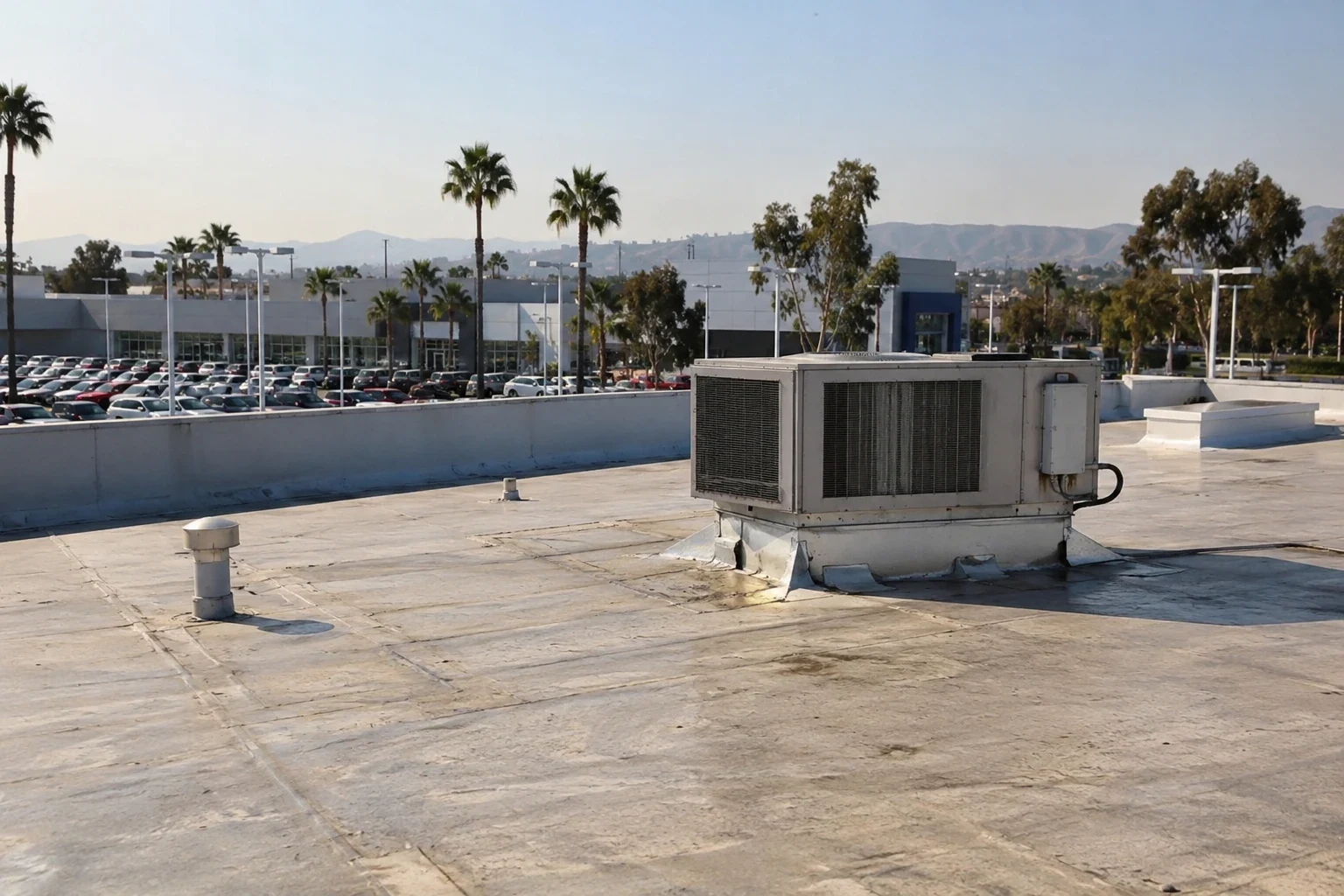
A deteriorated joint beside a service-bay exhaust needs its membrane, metal receiver and accessible termination examined. We record visible condition and identify whether removal is needed to establish a compatible connection. The presence of exhaust does not prove chemical damage or a particular roofing material. Where equipment performance or discharge affects the repair, the responsible mechanical participant reviews that question alongside the proposed waterproofing detail.
Restoring flashing at service equipment supports also requires usable height and sound receiving construction. Adding insulation can change the exposed curb available for a joint. We measure that relationship before specifying the roof field, and retain support or equipment adjustments as distinct tasks. The completed estimate should not depend on an unchanged curb that cannot receive the selected assembly.
A lifting area beside a vehicle display needs a defined separation from customer and employee movement. The dealership contact identifies the permitted route, inventory movement and access that must continue. We compare those requirements with the proposed roof phase and handling method. Removed material, delivered products and overhead work each need a practical location, rather than share an assumed open corner of the lot.
Construction above stored inventory can involve another protection arrangement within the same commercial property. At a dealership, vehicles may occupy both interior and exterior work-adjacent areas. Repeated relocation, limited lifting periods and smaller removal phases can affect price. We carry the agreed provisions with the covering quantity so the manager can evaluate a complete construction operation.
A ceiling complaint over a showroom display should be compared with roof penetrations, transitions and accessible drainage. We locate the reported interior position and photograph examined details that support or limit the proposed correction. Condensate or a wall connection may require another trade's investigation. The roof allowance retains that dependency instead of representing the nearest roof seam as the only possible entry path.
A targeted dealership leak investigation may require a permitted test or sample with protection beneath it. Its scope identifies the question to be resolved and how the opened position will be restored. Confirmed moisture can inform removal, but one local sample does not define every concealed layer. We connect any extended quantity with the examination needed to justify its boundary.
A roof replacement comparison needs the installed assembly and receiving details, not simply the date a dealership began operation. Plans published for Torrance Commerce Center in 2021 concerned industrial development. A dealership acquisition presents a different roof expenditure review, with showroom protection and service-equipment alterations carried alongside the covering. Matching available installation information to observed details helps identify which existing connection a proposed renewal would retain or reconstruct.
A roof survey for the dealership purchase identifies repair preparation, replacement tasks and information still needed to complete either option. Edge reconstruction, insulation changes and equipment coordination can influence cost independently of field area. Where a concealed receiver is uncertain, the estimate includes a measurement and authorization procedure. The buyer can then assess the expense without assuming that the transaction allowance settles every construction quantity.
A finished exhaust flashing should remain recognizable at its original roof coordinate. We retain preparation photos, installed connection information and the final boundary. Mechanical release, vehicle handling and any interior restoration have their assigned participants. Roofing completion demonstrates the agreed exterior correction; the dealership controls return of its sales or workshop area under the operating arrangement established for the work.
For a property in the Hawthorne Boulevard commercial corridor, the actual building and department remain identified in the closeout package. Applicable issued warranty instructions and upkeep at equipment joints accompany the construction description. Roof emergency assistance is available after sales and service hours, including nights and holidays. Safe access and permitted vehicle protection govern the immediate task, while temporary closure and permanent restoration remain separately recorded.
Dealership operations depend on clear customer circulation, vehicle protection and predictable service-bay access. Before work begins, map display rows, delivery doors, repair bays and sales entrances below each roof zone. Confirm where lifts and debris containers can sit without blocking emergency lanes or new inventory, and select work periods with the facilities manager. Inspect roof penetrations associated with exhaust or service equipment as separate details rather than assuming a field repair addresses them. If the schedule changes, identify affected operations and obtain approval for the revised sequence. Closeout photographs should show completed areas without capturing customer or vehicle information unnecessarily.
Compare their accessible construction, transitions and operating provisions before combining quantities. We locate each examined area and identify where material or equipment details differ. A shared property address does not establish one roof assembly. The estimate may use a common installation approach where supported, while retaining separate receiving corrections and protection needed above each department.
Discoloration alone does not establish material damage or its cause. We examine the accessible joint, receiving surface and related condition before selecting a waterproofing correction. Equipment discharge questions remain with the mechanical review where relevant. The scope should identify a supported repair and any useful confirmation rather than infer chemical exposure from the presence of a service bay.
Approved vehicle movement, lifting separation, interior protection and permitted removal periods can change the complete operation. We describe the handling plan with the dealership contact before carrying those tasks into the estimate. A smaller working phase can involve repeated setup and closure. Compare options using the same agreed restrictions so the covering amount does not conceal a different operating assumption.
Connect each allowance with its examined location, complete construction boundary and stated limits. We separate a supported correction from investigation or a proposed renewal. The buyer and its reviewing parties assess the resulting expenditure and any additional document requirements. Retain the survey basis after the transaction so later equipment changes can be compared with the assessed construction.